
 By: Bernardo Ferdman
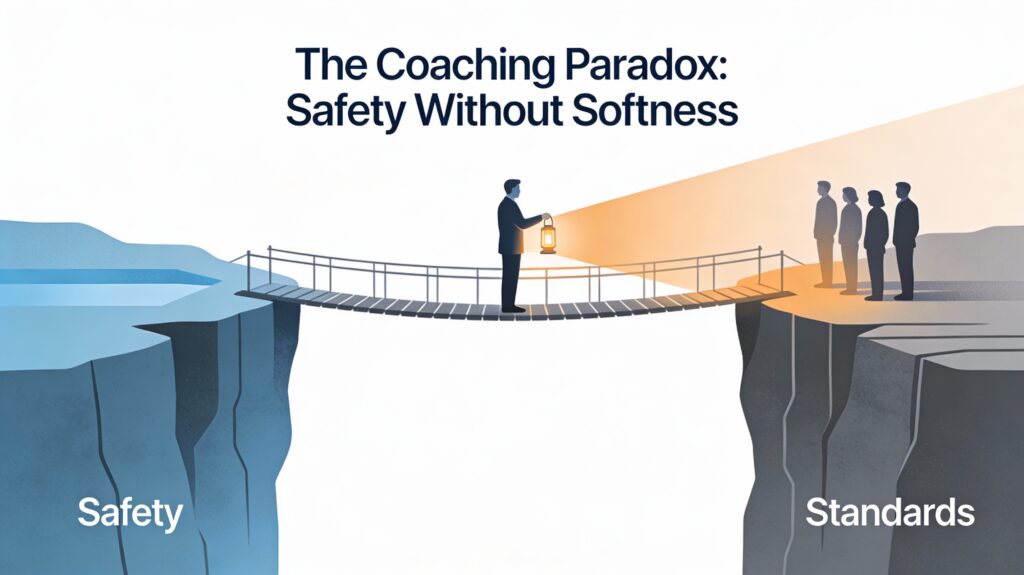
The Coaching Paradox: Safety Without Softness
When leaders talk about building a coaching culture, a concern often surfaces quietly—sometimes indirectly, sometimes not at all:
“If we create too much safety, won’t standards slip?” “If everyone’s encouraged to explore and question, won’t execution slow down?”
These are not bad questions. They’re honest ones. And they point directly to the paradox at the center of any real coaching culture: how to create psychological safety without lowering expectations.
Why This Tension Won’t Go Away
Psychological safety has become shorthand for everything from trust to kindness to flexibility. As a result, many leaders hear it as code for comfort. But safety is not the absence of challenge. It’s the absence of fear when facing challenge.
In organizations without enough safety, people manage risk by staying quiet, agreeing quickly, and avoiding experimentation. In organizations with too little structure, people may feel free—but unfocused.
A coaching culture requires neither silence nor looseness. It requires structured learning under real expectations.
Safety Is Not Softness
Psychological safety means people can:
- Ask questions without being labeled difficult
- Admit mistakes without being shamed
- Surface concerns without political fallout
It does not mean:
- Avoiding hard conversations
- Lowering performance standards
- Removing consequences
In fact, clarity makes safety possible. When expectations are vague, people fill the gaps with fear. When standards are explicit, learning feels less, rather than more risky..
This is where many coaching efforts falter. Leaders try to be supportive, but in doing so, they unintentionally create ambiguity. And ambiguity erodes trust faster than directness ever will.
Separate Learning From Evaluation or Don’t Expect Learning
One of the most common and damaging patterns in organizations is the quiet blending of learning and evaluation.
A leader asks reflective questions. An employee shares uncertainty or admits a mistake. Later, that moment reappears in a performance conversation. The message, even if unintended, is clear: reflection is not safe.
When learning is always evaluated, curiosity becomes performative. People share just enough to appear open, while protecting what actually matters.
A coaching culture depends on leaders being able to signal, clearly and consistently:
This conversation is about learning, not judgment.
That distinction doesn’t remove accountability. It creates the conditions where accountability can actually be met.
Space and Limits
Coaching cultures live in a tension that leaders can’t resolve, but only manage.
They require:
- Space for inquiry, reflection, experimentation
- Limits in the form of goals, timelines, roles, and standards
Too much space without limits leads to drift. Too many limits without space leads to compliance. Coaching is the practice of holding both at once, resisting the urge to collapse the tension by choosing one side.
This is harder than it sounds, especially under pressure. When time is tight or stakes are high, leaders often default to answers. Not because they don’t value learning, but because decisiveness feels safer.
Ironically, that’s often when learning is most needed.
Questions Matter, but So Does Intent
Coaching cultures don’t depend on asking more questions. They depend on asking honest ones.
People can tell when a question is an invitation—and when it’s a trap.
Questions that support learning:
- Surface assumptions
- Invite multiple perspectives
- Help people make sense of complexity
Questions that shut learning down:
- Lead toward a predetermined answer
- Signal disapproval disguised as curiosity
- Replace clarity with vagueness
Leaders in coaching cultures are thoughtful about when inquiry helps and when direction is required. Adaptive challenges call for exploration. Technical ones may not.
Coaching is not indecision. It’s discernment.
Why Leaders Struggle Here
This paradox asks leaders to do something deeply uncomfortable:
- Stay present when outcomes are uncertain
- Tolerate not knowing, without disengaging
- Hold people accountable and support their development
There’s no script for this. And no shortcut.
Coaching cultures are built through repeated moments where leaders choose learning over control, without abandoning responsibility.
That choice is visible. People notice it. And they respond accordingly.
Looking Ahead
Blog 1 focused on what makes coaching cultures possible, and this post names what makes them difficult.
In the next post, I’ll explore how coaching cultures actually take root: how they cascade (or don’t), why peer coaching matters, and what leaders can do to embed coaching into everyday work rather than treating it as an add-on.