
A senior executive recently told me, “I wanted to see how we could use AI to identify and respond to RFPs in a short period of time — I used Claude to create an RFP agent. It’s amazing how easy it was to change our whole approach.”
“Good for you,” I told him. “How will you use this to stay ahead of your competition?”
That question is at the heart of what it means to become an AI-Native organization.
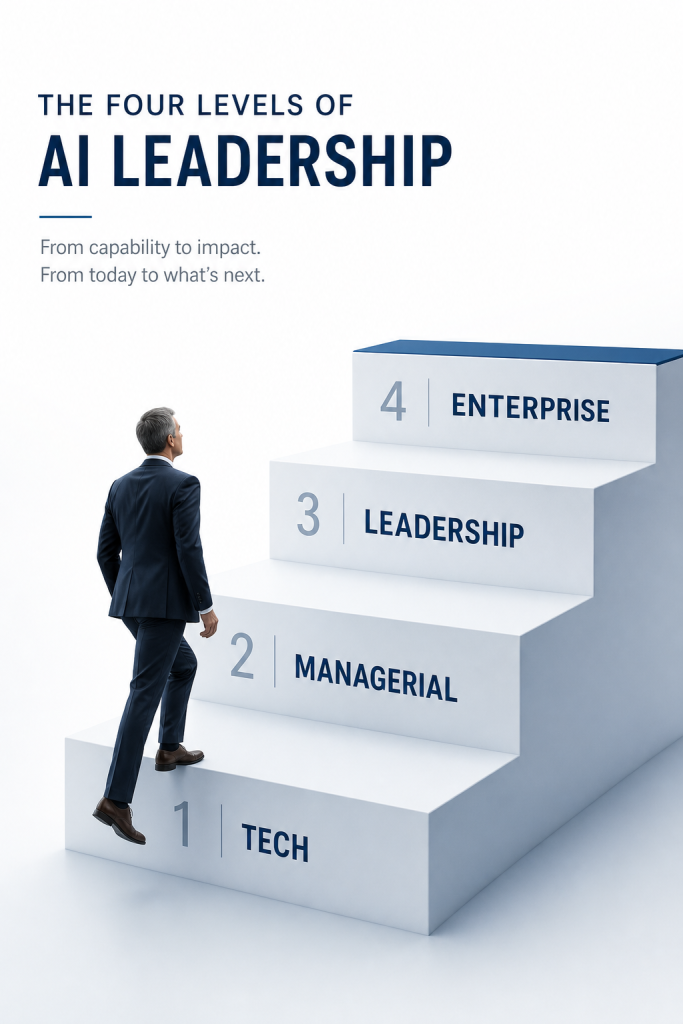
People and organizations in 2026 are in different stages of how they approach AI. There are four distinct levels, each requiring a different mindset, skillset, and set of actions from those in charge.
Level 1 — Technical: Understanding the Tools
At the technical level, the focus is on skill. Leaders explore AI tools, experiment with prompts, and build enough firsthand experience to ask better questions and evaluate what they are being told.
This is necessary. It builds credibility. But it is not the destination.
By the time any leader masters a given set of tools, a whole new generation of tools will have entered the market. The goal is not to become the best user of AI — it is to understand enough to guide the work.
In our AI-Native Leadership Program, even the most intensive executive track begins with hands-on exposure. We call this the Sorcerer’s Apprentice orientation — a nod to the idea that before you can direct the magic, you need to experience what it actually does. Leaders spend time working in the tools, not just hearing about them, precisely because lived experience is the foundation of credible leadership. You cannot redesign what you have never touched. And you cannot guide others through a transformation you have only read about.
Level 2 — Managerial: Enabling the Work
At the managerial level, leaders shift focus from personal fluency to team enablement. They introduce tools, support experimentation, and begin to see AI embedded in day-to-day work — increasing efficiency and throughput.
This is where activity accelerates. Use cases multiply. Pilots emerge.
But without clear direction from above, this energy often remains fragmented and produces incremental shifts rather than real transformation. The BLD Gold-level program addresses this directly: leaders are challenged to run real AI experiments, build team narratives around AI, and design human-centered workflows — not just manage a list of pilots.
Level 3 — Leadership: Redesigning the Work
At the leadership level, the focus shifts from use to value.
Leaders begin asking: Where does AI fundamentally change how this work should be done?
This requires analogical and conceptual reasoning — the ability to see patterns across domains, draw connections, and apply insights from one context to another. Leaders stop optimizingexisting processes and begin redesigning them from the ground up.
They stop asking “How do we use AI?” and start asking “How should this work be done now that AI exists?”
This is the level where the BLD 4Cs framework — Capability, Care, Connection, and Community — becomes essential. True AI-Native leadership is not just about efficiency. It is about how AI shapes human capability, how teams care for one another through change, how connection is maintained when work transforms, and how community and culture are strengthened, not eroded.
Level 4 — Enterprise: Aligning the System
At the enterprise level, the focus is integration and transformation.
AI initiatives are aligned across functions. Incentives are restructured to support new ways of working. Business models evolve. Products and services are fundamentally reconsidered. Data, processes, and decision-making connect across the organization.
This is where sustained value is created — not in pockets, but systemwide.
AI does not succeed in isolated pilots. It succeeds when it changes the way the company creates, delivers, and captures value. This is the work of executives — setting priorities, allocating resources, and redesigning the system. No one else can do it.
A Quick Self-Assessment
Where are you spending most of your time?
Technical
- I spend significant time learning tools and experimenting personally
- I focus on understanding capabilities and limitations
Managerial
- I am encouraging my team to use AI and running pilots
- We have multiple use cases but uneven results
Leadership
- We are redesigning workflows based on AI capabilities
- I am prioritizing where AI creates genuine business value
Enterprise
- AI is changing the products and services we deliver
- Incentives, processes, and culture reinforce the use of AI
Reflection question:
Which level are you strongest in — and which are you neglecting?
The Enterprise Mindset
The difference between these levels is mindset.
For the technician, the mindset is how to do the work. For the manager, it is how to encourage the work. For the leader, it shifts to how to change the methods, systems, and processes. For the enterprise-level executive, the mindset shifts again — to changing the business itself:
- Defining where value will be created
- Structuring how work gets done
- Enabling others to execute
- Adjusting the system as conditions change
Most executives have been rewarded for being excellent subcontractors — executing well within defined structures. Becoming AI-native requires them to operate as general contractors — holding the vision, orchestrating the work, and taking responsibility for the whole.
The Human Challenge
This shift is not purely strategic — it is psychological.
Leaders must operate in conditions where the answers are not clear, the expertise is distributed, and the outcomes are uncertain. This requires something beyond curiosity or openness. It requires courage: the willingness to move forward without full clarity, to let others lead in areas where they have greater expertise, and to accept imperfect progress over paralysis.
One of the most important things a leader can do in an AI-driven environment is stay clear on what human leadership actually contributes. AI can process, generate, and optimize — but it cannot replace ethical judgment, the ability to make purpose-driven decisions under uncertainty, or the human connection that holds teams together through change. These are not soft extras. They are the capabilities that determine whether AI transformation goes well or badly for the people inside it. Leaders who neglect them — in favor of chasing tools and efficiency gains — risk building organizations that are faster and more automated, but less trustworthy and less resilient. Developing and protecting these human capabilities is not a counterweight to AI adoption. It is what makes AI adoption sustainable.
Today’s leaders cannot be born AI-native — they grew up in a non-AI world. That means they must deliberately learn a new way of thinking, before the gap between them and the next generation compounds into something unrecoverable.
Leaders set the tone. If they hesitate, others will wait. If they create space, others will act.
What the organization needs from its executives is not prompts, tools, and proofs of concept. It needs a rethinking and redesign of the work, the workflows, the capabilities, and the systems in which AI creates, delivers, and captures value — and it needs the resources, time, and priorities that only executives can authorize.
That is the work. The BLD AI-Native Leadership Program is designed to help you do it.