
Can AI Replace Executive Coaching? What Organizations Need to Understand
By: Guest Contributor Stephen Dwight, Ph.D. Chief Talent Officer and Scott Serviss, Psy.D., Partner
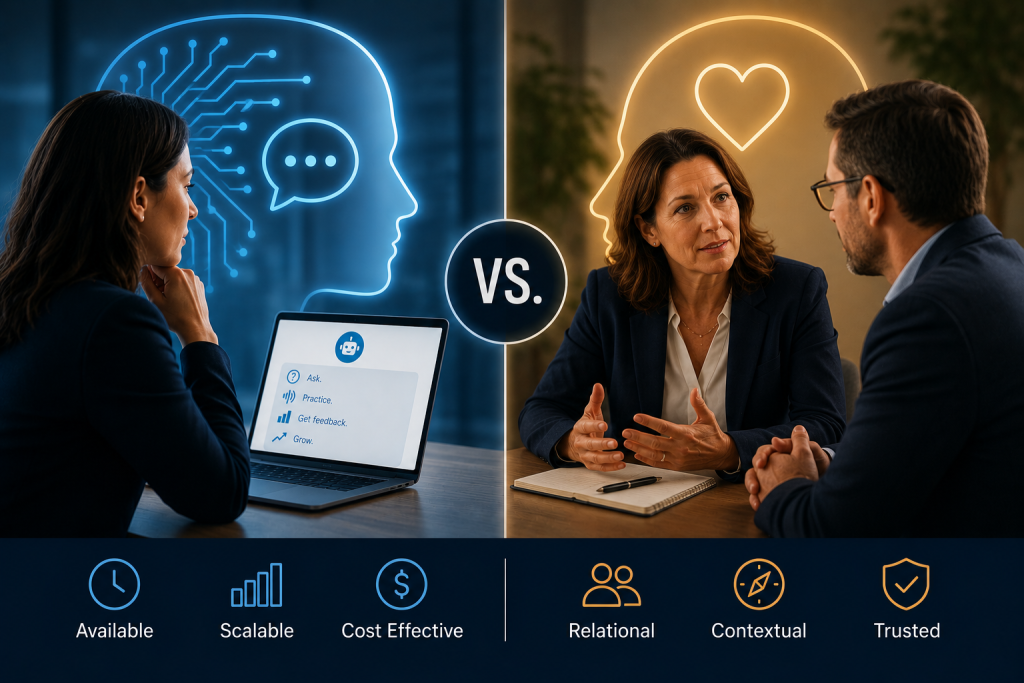
As AI grows more sophisticated, organizations are increasingly asking how much AI coaching can replace or supplement human coaching — reducing costs while potentially expanding access to leadership development across the organization.
For organizations facing financial pressure, understanding the real trade-offs matters. While AI coaching offers clear advantages in accessibility and scale, executive coaching has never been solely about efficiency. The question is not whether AI coaching is useful. It is where it creates value — and where human coaching remains essential.
What AI Coaching Does Well
Availability and Accessibility
A leader wrestling with a difficult decision at 11 PM can access support immediately — no waiting for a Thursday coaching session. For organizations operating across multiple time zones, that immediacy is meaningful.
AI coaching also removes many of the scheduling and logistical barriers that traditionally limit access to leadership development.
Low-Stakes Practice
AI provides a judgment-free environment for rehearsing difficult conversations — tough feedback, negotiations, and high-stakes meetings — where leaders can iterate and refine without concern for how they are perceived.
For many leaders, the ability to practice repeatedly and privately can help build confidence before entering difficult situations.
Pattern Recognition and Feedback Analysis
AI can synthesize communication patterns and surface blind spots across large volumes of interactions and feedback in ways that might take a human coach significantly longer to uncover.
Used thoughtfully, this can help leaders identify recurring habits, communication tendencies, and areas for growth more quickly than traditional approaches alone.
Scale and Cost Efficiency
Organizations can extend coaching support to a broader leadership population at a fraction of the cost of traditional executive coaching — reaching leaders who might never otherwise have access to structured development support.
For many companies, this is one of AI coaching’s greatest advantages: expanding leadership development more broadly across the organization.
Where AI Coaching Falls Short
Relational Depth
Executive coaching works largely because of the relationship — the trust built over time, the coach who knows your personal situation, who remembers that you shut down when ambushed, who reads what you are not saying.
AI can simulate conversation. It cannot replicate genuine human relationship.
Organizational and Political Judgment
Skilled coaches understand power dynamics and help leaders navigate charged situations with nuance — when to escalate, when to concede, how to manage a difficult board member, or how to communicate during organizational tension.
These are deeply contextual judgments that AI is poorly equipped to make.
Holding Space for Vulnerability
The most transformative coaching moments often involve silence — when a leader finally admits they are terrified, exhausted, or burned out.
AI can prompt reflection. It cannot truly hold that moment.
Ethical Weight and Accountability
Human coaches can push back on rationalizations and bring genuine moral gravity to decisions that ripple outward to employees, communities, and shareholders.
AI, as it currently exists, cannot provide that level of ethical presence or accountability.
A Practical Framework: Complexity and Cost
One practical way to think about AI coaching versus human coaching is across two dimensions: complexity and cost.
AI coaching can provide meaningful support across many levels of leadership, particularly in areas where leaders benefit from consistent practice, structured reflection, and immediate accessibility. For many organizations, this creates opportunities to expand leadership development more broadly than traditional coaching models alone allow.
As leadership complexity increases, however, the value of experienced human coaching becomes more significant. Senior leaders often face highly contextual decisions involving organizational politics, ambiguity, competing stakeholder pressures, and emotional nuance — areas where relational trust, discretion, and human judgment matter deeply.
At that level, experienced executive coaches remain not just valuable, but the right investment.
AI Coaching and Human Coaching Are Not Competing Models
AI and human coaching are not in competition. They serve different functions and different organizational needs, and companies that recognize this will deploy both more effectively.
AI coaching can expand access, reinforce learning, and provide scalable developmental support. Human coaching remains critical where complexity, emotional nuance, political judgment, and organizational consequence matter most.
The mistake is treating cost as the only variable.
Organizations that default to the cheapest option regardless of context risk under-serving the leaders whose decisions matter most to the organization’s long-term success.