
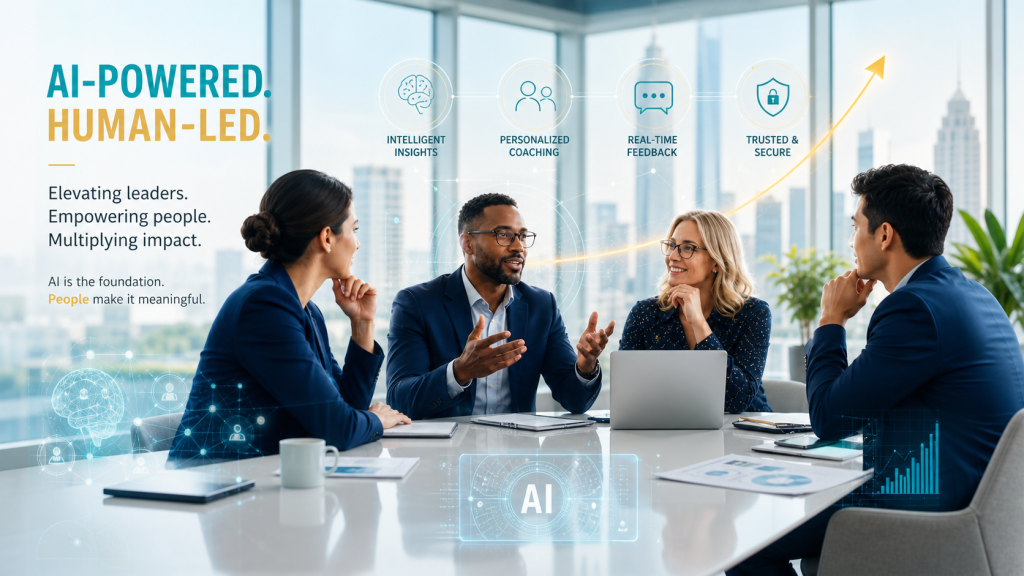
AI Coaching: A Multiplier for Human Leadership Development
By: Guest Contributor Ellie Eckhoff — Executive Coach & Leadership Team Consultant
Once organizations accept that AI can support coaching, the more consequential question becomes how AI changes the coaching culture—and whether it strengthens or weakens the human leadership systems that develop leaders.
What CHROs and Business Leaders Need to Get Right
As organizations invest in AI coaching, the conversation is quickly moving beyond whether it works to a more strategic question: what happens to leadership capability, talent pipelines, and performance when AI enters the coaching system?
The International Coaching Federation (ICF)—the world’s largest professional coaching organization—has consistently found that coaching cultures are most effective when managers, HR, and external coaches share responsibility for development, rather than when coaching is treated as something tools or programs can own. That insight matters even more in an AI‑enabled environment.
Where AI Coaching Creates Real Leverage
When designed well, AI supports the realities CHROs and business leaders face, including distributed workforces, manager capability gaps, limited coaching capacity, and the pressure to scale development efficiently.
AI can:
- Prepare leaders for higher‑quality development and performance conversations
- Reinforce reflection and follow‑through between manager touchpoints
- Provide low‑stakes practice for critical leadership skills
- Expand access to development without ballooning cost
In these roles, AI improves the quality and consistency of leadership thinking across the organization. This is where AI becomes powerful – not as a replacement for coaching, but as a multiplier of effective leadership development.
Where AI Cannot Replace Human Judgment
What AI cannot replace – and where CHROs should draw a clear line – are the internal relationships that determine whether development translates into results. Essential elements that require the human touch include:
- Managers who connect growth to real work, performance, and opportunity
- HR leaders who see patterns across teams and intervene strategically
- Trust built through repeated human interaction
- Sponsorship, advocacy, and judgment in performance, promotion, and succession decisions
When development shifts primarily into private AI interactions, organizations risk weakening managerial coaching capability and losing visibility into emerging talent risks. Coaching becomes individualized rather than cultural – and leadership pipelines quietly thin.
An Enabler or a Multiplier?
ICF research positions AI as an enabler of coaching behaviors. In practice, organizations that design it intentionally experience something stronger: AI becomes a multiplier.
It multiplies:
- Strong managers
- Thoughtful HR systems
- Healthy coaching cultures
It also exposes gaps when those foundations are weak.
Why This Is a Business Issue, Not Just a Talent One
Research consistently shows that organizations with strong coaching cultures retain high performers at higher rates, driven by meaningful manager relationships. They also build stronger leadership pipelines through visibility and sponsorship over time, and outperform competitors, as better judgment and accountability translate into execution.
ICF research links coaching cultures to higher engagement and leadership effectiveness. Complementary research from Gallup shows that employees who experience frequent, high‑quality manager conversations are significantly more likely to stay, perform, and grow.
AI coaching can accelerate these outcomes—but only when it strengthens the human system. When it replaces it, the opposite occurs: weaker relationships, thinner pipelines, and disengagement that compounds quietly.
Final Thought for Leaders
AI will change how coaching is supported. It should not change who owns leadership development.
The organizations that get this right will retain critical talent, expand their leadership bench, and outperform peers—because they designed AI to multiply strong human leadership systems, not replace them.
This is exactly the conversation we’ll be exploring with CHROs and business leaders at our upcoming HR lunch in Boston on May 28th.
Learn more, or reserve your seat here.
Please note, the event is limited to 16 attendees.